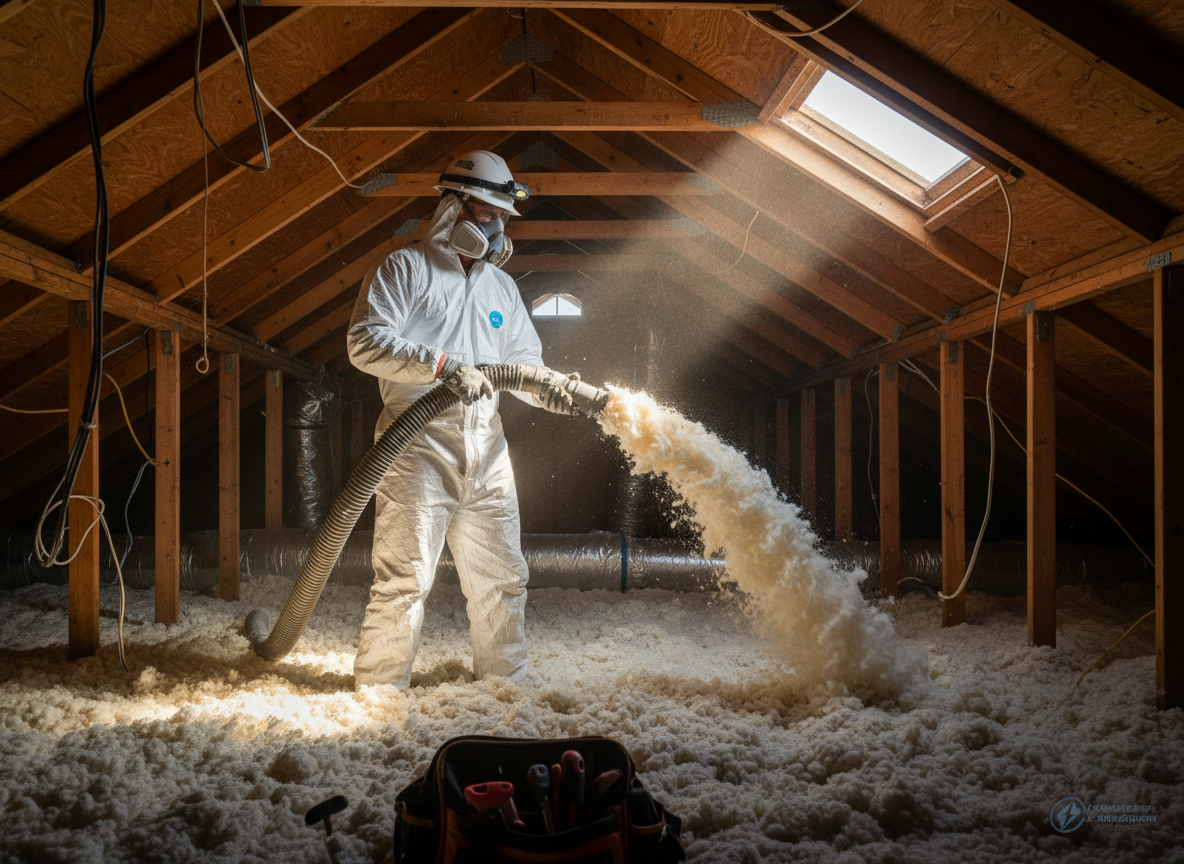
South Salt Lake sits between the busy 2100 South corridor and the Mill Creek drainage, where many 1950s and 1960s bungalows and split-levels still have original loose-fill or minimal batts that have settled over decades. Ridgewarm Circle crews reach these homes from the 1895 E Rodeo Walk Dr base and work around narrow attic hatches, knob-and-tube wiring, and low knee walls common in the neighborhood.
Winters bring heavy snow load and rapid temperature swings that push heat out through poorly sealed ceilings. We focus on air sealing at the top plates and adding insulation depth that matches the actual rafter height in these Salt Lake County homes so the heating system does not run constantly once the first big storm hits.
Summer heat builds fast under dark asphalt roofs along State Street. Proper attic ventilation and insulation keep second-floor bedrooms cooler without relying on oversized AC units that many South Salt Lake residents already struggle to fit in small lots.
Around South Salt Lake
We regularly work near:
- 📍Fitts Park
- 📍2100 South
- 📍State Street
- 📍Central Park
- 📍South Salt Lake City Hall
- 📍South Salt Lake Library
Attic Insulation in South Salt Lake — Local Notes
- •Many South Salt Lake homes along 2100 South and Central Avenue have balloon framing with open wall cavities that let cold air reach the attic; sealing these bypasses is required before adding new insulation.
- •Narrow driveways and alley access near Fitts Park mean equipment must be carried in by hand on most jobs, lengthening setup time compared with newer subdivisions.
- •Homes within a block of the creek often show higher moisture readings in winter; we install vapor-permeable insulation and check for ice dam risk at the eaves.
- •Older South Salt Lake roofs frequently have 2x4 rafters on 24-inch centers, limiting insulation depth unless baffles and raised heel trusses are added during the job.