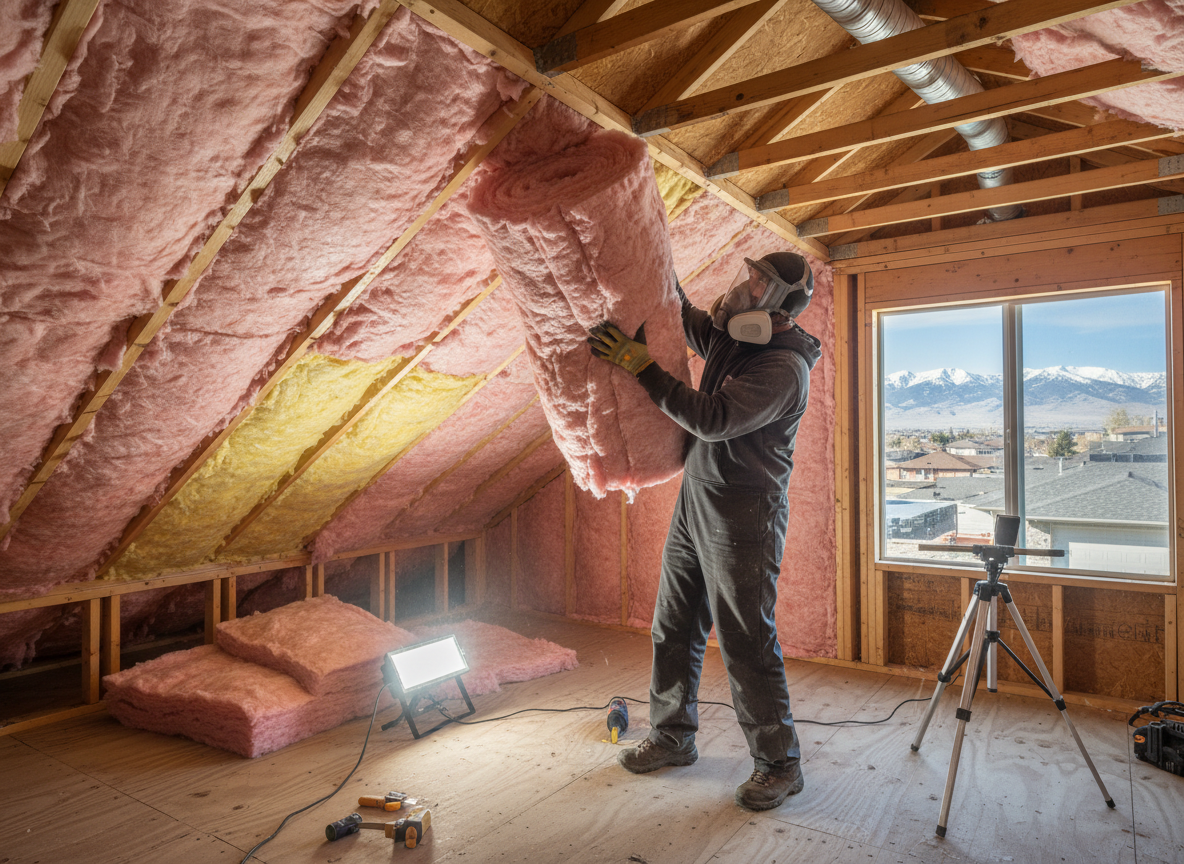
Holladay homes built before the 1980s in neighborhoods like Mount Olympus and Holladay Village often have thin or settled fiberglass that fails once winter temperatures drop and snow loads press on the roof deck. We measure existing R-values in the attic, check for gaps around recessed lights and plumbing chases common in these mid-century builds, and add new kraft-faced or unfaced batts only where they won't trap moisture from the semi-arid climate's temperature swings. Proper baffles and ridge venting keep air moving so ice dams don't form along the eaves near Olympus Hills Park.
Fiberglass performs differently in Cottonwood Heights and Millcreek border homes where attic access is limited by low-pitch roofs and blown-in material already present. We remove compressed sections, seal penetrations with foam, and layer new fiberglass perpendicular to joists to reach code minimums without blocking soffit vents. This approach handles the hot summer heat gain that drives up cooling costs in Salt Lake County while preventing the condensation that appears when warm indoor air meets cold roof sheathing.
Edge cases we see regularly include knob-and-tube wiring in older Holladay Village properties and bathroom exhaust fans venting into the attic instead of outside. Fiberglass must stay clear of these fixtures to avoid fire hazards and moisture buildup. We also address the terrain factor of sloped lots near Mount Olympus where one side of the attic sits higher and collects more drifting snow, requiring extra insulation depth on the north-facing slope.
Technician insight
In Holladay, the thing that catches most people out with fiberglass insulation is how snow drifting on the north slopes of Mount Olympus homes compresses old batts and creates hidden voids right where heat loss is worst. Homeowners often add new layers on top without clearing the compressed stuff first, which just traps the problem in place.
Compressed Insulation in Mount Olympus Attic
A 1970s split-level near Olympus Hills Park showed high heating bills despite added insulation. We found heavy snow loads had flattened the original fiberglass along the north roof plane. We removed the compressed sections, sealed several bypasses, and reinstalled fresh batts to full depth while preserving ridge ventilation. The homeowner reported steadier attic temperatures the following winter.
How it works
- 1
Attic Assessment
We inspect insulation depth, ventilation, and moisture in homes across Holladay Village and Mount Olympus to identify gaps caused by snow load or age.
- 2
Preparation and Safety
Existing material is cleared around lights and vents, air sealing is completed, and protective barriers are placed before any new fiberglass is handled.
- 3
Installation
Fiberglass batts or rolls are cut and fitted to joist spacing typical in Salt Lake County homes, ensuring full coverage without compression near ridge vents.
- 4
Final Check
We verify R-value targets, confirm airflow through soffits, and walk the homeowner through the finished work in the attic.
Pricing
Cost depends on attic size, existing material condition, and access difficulty in homes near Holladay City Park or Cottonwood.