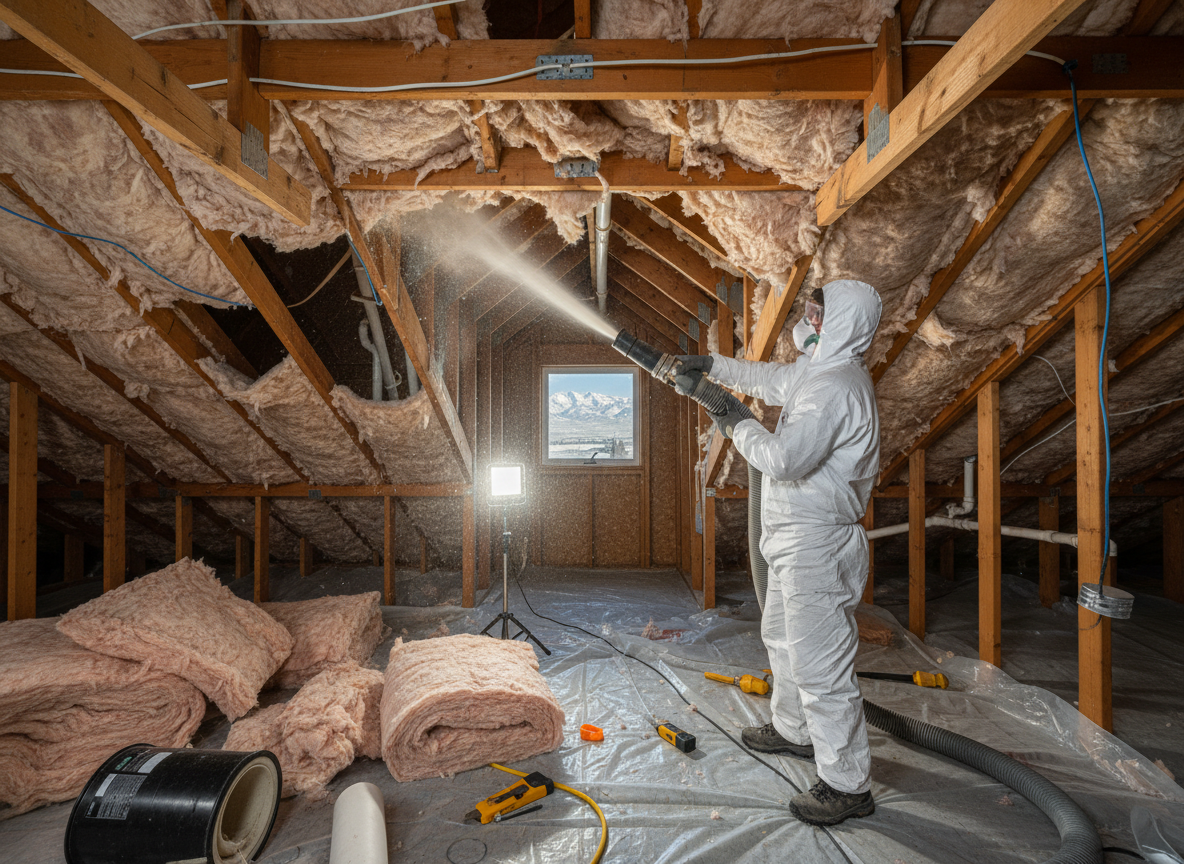
Holladay sits in Salt Lake County with a semi-arid climate that brings hot summers and cold snowy winters. Older homes in Holladay Village and Mount Olympus often have original batt insulation that has settled or been damaged by roof leaks during heavy snow years. Emergency calls usually come after a sudden cold snap reveals gaps around recessed lights or plumbing penetrations, letting heat escape and driving up utility costs in single-story ranch houses common to Cottonwood and nearby Millcreek.
Technicians responding from 1895 E Rodeo Walk Dr Suite B200 work around the clock because winter storms can create ice dams that force water under shingles and saturate cellulose or fiberglass. In these cases crews must first locate the moisture source from the attic side, remove wet material to prevent mold, then install new vapor-retardant faced batts or blown-in cellulose to match the existing R-value while maintaining proper ventilation at the eaves. Homes near Olympus Hills Park frequently have low-slope sections that trap snow, making access ladders unstable and requiring extra safety measures before any material is touched.
Salt Lake County building practices from the 1960s and 1970s left many attics with minimal baffles and blocked soffits, so emergency repairs also include restoring airflow to avoid future condensation on roof sheathing. When working in Cottonwood Heights or near Holladay City Park, crews check for knob-and-tube wiring and update blocking around chimneys to current clearance standards before adding insulation. This prevents both fire hazards and callbacks once temperatures drop again.
Technician insight
In Holladay the thing that catches most people out with emergency insulation repair is how quickly settled cellulose in 1970s Mount Olympus homes turns to mush once snow sits on the roof for a week. The low eaves on those single-story houses make it easy to miss the water until the furnace runs nonstop and the ceiling stains appear.
Ice Dam Leak in Holladay Village
A homeowner in Holladay Village noticed ceiling stains after a January warm spell. We found saturated cellulose along the north eaves where an ice dam had formed. Crews removed the wet material, cleared blocked soffit vents, and replaced the insulation with new cellulose while restoring airflow, stopping further heat loss before the next cold front arrived.
How it works
- 1
Initial Assessment
Technician arrives within hours, enters the attic safely, and identifies the source of insulation failure whether from moisture, settling, or animal activity.
- 2
Containment and Removal
Wet or damaged material is isolated and removed to stop mold spread, with debris bagged and carried out without disturbing living spaces below.
- 3
Source Repair Coordination
Any roof or vent leaks are noted and flagged for a roofer if needed, then ventilation paths are cleared before new insulation is placed.
- 4
Re-insulation and Verification
Matching material is installed to restore thermal performance, baffles are reset, and the homeowner receives a walk-through of the completed work.
Pricing
Pricing varies by attic size, depth of damage, and whether roof leaks must be addressed first; quotes are provided after the on-site assessment.