2026-10-24 ·
Balancing Attic Insulation with Ventilation During Utah Inversions
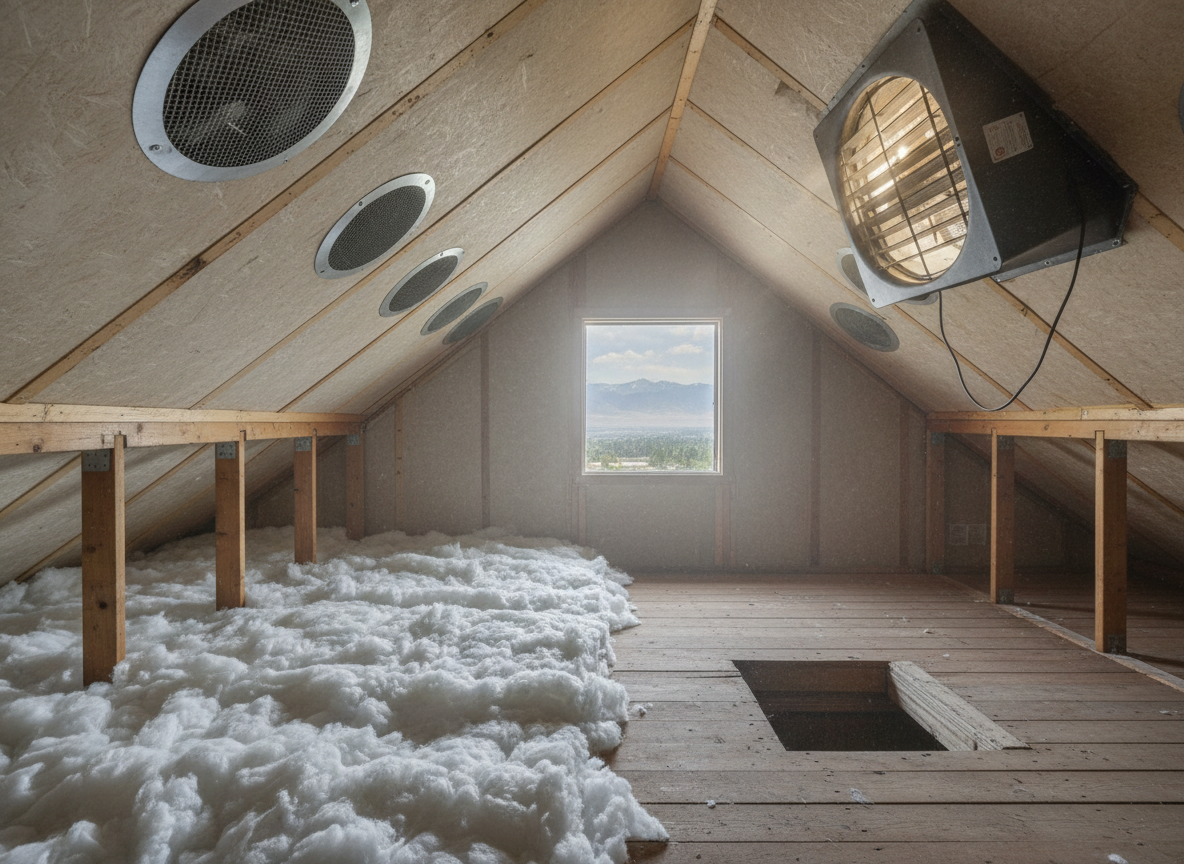
In Holladay homes, the key to balancing attic insulation with ventilation during Utah inversions is maintaining at least 1 square foot of net free vent area for every 150 square feet of attic floor while achieving R-49 insulation levels above living spaces. This ratio prevents moisture from trapped cold air and pollution from building up on rafters and sheathing during the multi-day inversion events common in Salt Lake County from December through February. The approach works because inversions create a stable layer of cold air that limits natural airflow, so mechanical or passive vents must be sized and placed to move air without pulling in outdoor pollutants that settle in lower valleys.
How Inversions Interact with Local Housing Stock
Holladay Village and Mount Olympus neighborhoods contain many pre-1980 homes with rafter spaces that were originally built with minimal insulation and basic ridge vents. These older structures sit on slopes that funnel cold air downward during inversions, causing attic temperatures to drop faster than in flatter sections near Holladay City Park. When insulation is added without adjusting vents, relative humidity inside the attic can climb above 60 percent, leading to frost on nails and potential mold on cellulose. In contrast, homes near Olympus Hills Park often have cathedral ceilings that limit soffit venting, requiring ridge vent extensions or gable vents to restore balance. The semi-arid climate means summer drying helps, but winter snow loads on roofs in Cottonwood Heights and Millcreek can block lower vents for weeks, changing how much ventilation capacity remains effective.
Practical Steps for Adding Insulation Without Reducing Airflow
Start by measuring existing vent openings in the eaves and ridge before any material goes in. Use blown-in cellulose or fiberglass at densities that leave a 2-inch air channel above the insulation along the roof deck so air can still travel from soffit to ridge. In Salt Lake City–adjacent blocks of Holladay, many crews install vent baffles first on every rafter bay to guarantee the channel stays open even after 12 inches of insulation settles. Avoid blocking any existing gable vents, especially on homes with hip roofs common in the Mount Olympus area. After installation, check that bathroom and kitchen exhaust fans still terminate outside rather than into the attic, since inversion conditions reduce the stack effect that normally pulls moist air out. This sequence keeps the home warmer in winter while preserving the drying potential needed when temperatures rise again.
Long-Term Monitoring in Holladay Conditions
Homeowners in Cottonwood and nearby Millcreek can track performance with a simple attic humidity sensor placed near the ridge. Readings that stay between 30 and 50 percent during an inversion indicate the insulation-to-ventilation ratio is working. If levels climb, adding a solar-powered ridge vent or increasing soffit openings by 20 percent often corrects the issue without removing insulation. Pre-1980 houses in Holladay Village frequently benefit from this adjustment because their original construction left larger rafter bays that accommodate both insulation and airflow. Regular checks after heavy snow events ensure vents remain clear, since blocked intakes turn even well-insulated attics into moisture traps during prolonged cold spells.
For deeper guidance on older Holladay homes, see fixing drafty attics in pre-1980 Holladay houses and attic insulation and summer heat gain near Big Cottonwood Canyon. Ridgewarm Circle provides attic insulation services from its base at 1895 E Rodeo Walk Dr Suite B200, Holladay, UT 84117 and remains available 24/7 for assessments during inversion periods.